Imerys reaffirms its commitment to biodiversity with act4nature international
As we celebrate the United Nations International Day for Biological Diversity, we are proud to announce the renewal of our act4nature international commitments for the period 2025-2028. This renewal marks a significant step in strengthening our action plan to preserve natural heritage.
As a world leader in mineral-based specialty solutions for industry, and signatory of act4nature international since 2018, we recognize that our activities put pressure on ecosystems. Protecting biodiversity is therefore at the heart of our purpose: Unlocking Better Futures for our people, our customers, and our planet.

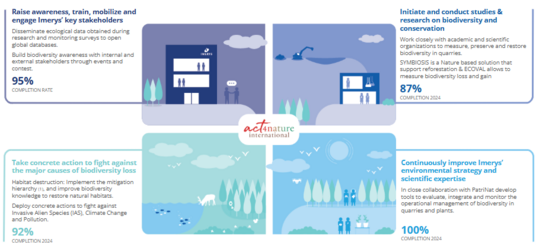
94% of our 2020-2024 goals achieved
Scientific partnership to drive a more impactful action plan
During the 2020–2024 commitment period, we worked with scientific partners, including PatriNat, to better understand our biodiversity impacts. In parallel, we conducted an analysis that showed that extraction activities are our main source of pressure on biodiversity, particularly through the destruction of natural habitats. It also helped identify opportunities for biodiversity management, conservation, and restoration on our sites.
Concrete progress thanks to employee engagement
We fully met 94% of our commitments. This success was made possible by the dedication of our teams on-site and in support functions across Imerys. These results demonstrate our ability to turn ambitions into tangible action and progress for a better future.
Detailed results are available in the 2024 Biodiversity Report and our 2024 Universal Registration Document.
2025-2028 ambition: work toward no net loss of biodiversity
For this new commitment period, our main objective is to address all stages of the biodiversity mitigation hierarchy - Avoid, Minimize, Reduce, Offset - in our efforts to preserve and restore nature. Simultaneously, we are carrying forward select actions from our previous commitments.
This approach ensures continuous improvement, allows for upscaling of successful initiatives, and maintains alignment with our top priorities.
What do we plan to do concretely?
- Biodiversity audits: By the end of 2025, 20 priority sites will be audited to identify improvement areas. By the end of 2028, all will have reached the best level of environmental management in our maturity matrix.
- Avoid sensitive areas: From 2025, no new extractive sites will be opened in UNESCO or IUCN categories I, II, III. All new sites within 5 km of sensitive areas will implement biodiversity protection measures.
- Ecological rehabilitation: By the end of 2028, 100% of priority sites will have a rehabilitation plan audited by internal experts.
- Impact reduction: By the end of 2028, key issues related to invasive species will be identified and best practices shared
Key figures
With our new 2025–2028 act4nature international commitments, we are strengthening our concrete, measurable, and collective actions to protect natural heritage.
FAQ
Led by Entreprises pour l’Environnement (literally, “Companies for the Environment”), this voluntary initiative is a French coalition of companies, public actors, scientists and environmental associations who are committed to protecting, enhancing and restoring biodiversity. Imerys has taken part in the launch of act4nature international, which continues act4nature’s work by encouraging business leaders of companies with global activities to make biodiversity as great a priority as climate change. The initiative includes both shared commitments among all signatories and individual commitments, presented here.
Mitigation hierarchy is a widely used scientific approach that aims to limit the negative impact on biodiversity based on a step methodology of avoiding, minimizing, restoring and finally offsetting the impact. The biodiversity mitigation hierarchy is the cornerstone of our biodiversity policy.
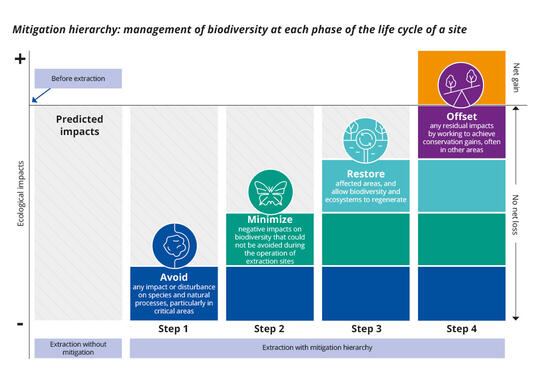

Preserving biodiversity also means looking beyond our sites. When our impacts on nature cannot be totally avoided, reduced or restored, we move on to the ultimate stage: offset. This final phase of the biodiversity mitigation hierarchy aims to balance the scales by generating biodiversity gains outside our sites at least equivalent to the losses caused by our activities.
Discover how we implement offset measures through concrete examples of wetlands and habitat restoration in Sandersville, USA, and in Clérac, France.

From a volcanic island in Greece to a forest in Austria, we adapt to the unique local climatic conditions of each site with the same objective: to bring nature back by restoring our quarries.
When our impacts on nature cannot be completely avoided or minimized, the third step of the biodiversity mitigation hierarchy aims at repairing what extractive activities are altering.

In this third article of our biodiversity campaign, we move on to the second step of the mitigation hierarchy: Minimization. This step of the biodiversity mitigation hierarchy, focuses on reducing residual impacts throughout the lifecycle of our projects. By combining scientific expertise, local adaptation, and employee engagement, Imerys is actively working to minimize its impact on natural heritage. From protecting peregrine falcons in the United Kingdom (UK) to managing invasive species in Thailand, our teams around the world are taking actions to safeguard biodiversity.

To preserve natural heritage, it is essential to anticipate and limit impacts right from the project design phase. This involves rigorous analysis of the ecological context and the implementation of appropriate measures to minimize our footprint on ecosystems.
In the previous article, we presented our commitments, strategy, protocols and tools built with scientific experts and deployed across the Group to help protect biodiversity. For this second article, we talk about the first and crucial stage of the biodiversity mitigation hierarchy.